+91 9747375599
Apply Now

Diploma in Jewellery Designing (1 Year)

1 Year Course • Calicut, Kerala

Our 1 Year Diploma in Jewellery Designing in Kozhikode (Calicut) is certified by NSDC and takes you from sketching and rendering to gemology, computer aided design and jewellery manufacturing. It is a complete foundation for a creative career...

🎓 NSDC Certified 💎 Gemology + CAD + Manufacturing 👩 Women's Only

Course at a Glance

🗓️
1 Year Duration
🎓
NSDC Certified Diploma
📚
6 Subjects + Internship
🏫
Offline Study Centre
📖
Eligibility Plus 2 / VHSE
🎂
Age Limit Up to 30 Years
👥
Seats per Batch 20 students
🔙
Class Timings Monday - Friday
(5 Days / Week)
(9:30 AM - 3:15 PM)
💳
Payment Semester wise
🏠
Hostel Facility Available
👩
Female Only Course
🚫
No Uniform Relaxed Campus
🔗 Quick Navigation

Quick access to everything about the Diploma in Jewellery Designing course.

Learn Diploma in Jewellery Designing at Waves Institute of Fashion Designing, Kozhikode
The Course

About Diploma Course in Jewellery Designing

Jewellery has always been a woman's first love. We admire a good design, but only few of us know, how such designs are created. Jewellery Designing (Jewelry Designing) is one of the fastest growing sectors in the world. The art of Jewellery Designing is the one that requires training, creativity and an eye for detail.

Waves Institute of Fashion Designing gives aspiring women a chance to take Jewellery Designing up as a career. The 1 Year Diploma in Jewellery Designing is certified by the National Skill Development Corporation (NSDC). It covers Jewellery Design, Gemology, Merchandising and Jewellery Manufacturing, with practical, hands-on learning at the centre of every semester.

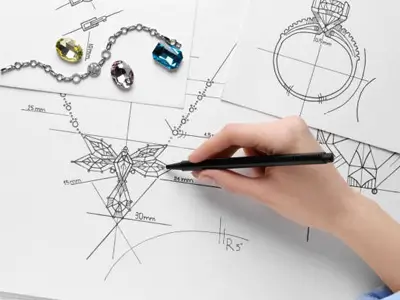
Students work with drafting tools, learn to illustrate form, shape and texture, and render white and yellow metals. Classes are practical-led and end with an internship and a portfolio of finished designs.
What You Will Learn

Skills You Build in One Year

From the first pencil sketch to the finished piece, you learn every step of how jewellery is imagined, drawn, valued and made.

Illustration

Draw form, shape and texture of jewellery pieces like rings, pendants, earrings, bracelets and necklaces.

Computer Aided Design

Learn designing with software like Rhino, Photoshop, CorelDraw & Adobe Illustrator to produce 2D/3D designs.

Study of Gems and Stones

Identify, grade and understand gemstones and diamonds.

Display of Creative Art

Present your designs through a finished portfolio and research booklet.

Free Hand Drawing

Sketch confidently, including live drawing practice.

Designing Jewellery to Detail

Stone setting, clasps, chains and decoration techniques.

Exploring Designs and Patterns

Repetition, rotation, mirroring and graduation.

Perspective Drawing

Scale, proportion and perspective for accurate drawings.

Rendering Metals & Stones

Render yellow and white metals and gemstones in black-and-white and colour.

Alloys, Casting & Hallmarking

Calculate alloy composition and carat. Learn casting methods, assaying, BIS hallmarking.

Costing & Export

Estimate costing and pricing for export and domestic orders.

Career Opportunities

Scope of Diploma Course in Jewellery Designing

Jewellery has always been part of human society, which makes this an evergreen career area. After this course you can begin in many roles, depending on your interest and strengths:

Jewellery Designer
Jewellery Merchandiser
Production Manager
Lecturer
Jewellery Maker & Innovator
Manager in Museum & Art Gallery
Illustrator
Entrepreneur
Gemstone Appraiser
Gem Assorter
Jewellery Historian
Grading Consultant
Why Choose WIFD

Top Reasons to Join Jewellery Designing at WIFD

🎓
01

Certified by NSDC

A 1 Year Diploma is certified by the National Skill Development Corporation, giving your training a recognised national standing.

🔬
02

Practical Training & Labs

Intensive exposure to practical work, with emphasis on hands-on training using the advanced lab equipment.

📚
03

Latest Syllabus

A syllabus built to stay in step with the current market trend, from design to manufacturing and export.

🤝
04

Internship and Placements

Internship and placement opportunities with leading firms in the jewellery industry.

💎
05

Explore Different Materials

Work with different materials to create innovative designs and accessories, not just one style.

🌿
06

Inspiring, Eco-Friendly Campus

Learn at Providence Women's College, a NAAC A++ accredited campus on a green hilltop in Providence Women's College, Malaparamba.

🏠
07

Safe Hostel with Food

A safe and secure hostel facility with food is available for students from outside Kozhikode.

👩
08

Women-Only Learning

A focused, comfortable learning space designed for women who want to build a career in jewellery.

💳
09

Semester Fee Payment

Pay the course fee semester by semester. Call us on +91 9747375599 for the latest fee details.

Syllabus

Curriculum & Subjects

The curriculum covers every step of jewellery design, from choosing raw materials and designing patterns to rendering with drafting tools and executing the design to perfection. The 1 Year Diploma has 6 subjects: Design Concept, Marketing & Law, Gemology, Computer Application, History of Jewellery and Jewellery Manufacturing, followed by an internship.

Design, sketching, rendering & portfolio

Basic Design Concept

  • What is Design?
  • Design Sources
  • Creativity and Design Process
  • Pattern in Combination
  • Repetition, Rotation
  • Mirroring, Graduation
  • Exaggeration
  • Elements of Design
  • Principles of Design
  • Stone Setting
  • Clasps, Chains
  • Enhancement of a Design Using Decoration Techniques
  • Size Parameters of the Jewellery Design

Free Hand Drawing and Sketching PRACTICAL

  • Construction & Analytical Method
  • Relation Between Size
  • Scale and Proportion
  • Perspective Drawing
  • Free Hand Drawing
  • Black & White and Colour Rendering
  • Live Drawing

Rendering Techniques & Designing PRACTICAL

  • Basic Designing & Rendering
  • Rendering of Different Metals & Stones

Portfolio Designing PRACTICAL

  • Women's, Kids' and Men's Jewellery Designing
  • Inspiration Board
  • Costume Jewellery
  • Situation Test
Export, Marketing & Brand building

Export Procedure

  • International Trade
  • Features of International Trade
  • Advantages & Limitations
  • Home Trade v/s International Trade
  • Documents Involved in Export Trade
  • Trade Barriers and Trade Blocks
  • Export Trade & Procedure
  • Export Assistance & Incentives
  • Export Costing and Pricing
  • Export Promotion

Marketing, Advertisement & Brand Building

  • Retail Operations and Logistics
  • Trade Promotions
  • Legal Aspects in Trading
  • Strategy Management
  • Introduction to Basic Marketing Concepts
  • Market Research & Product Management
  • Sales & Brand Management
  • Space and Layout Management

More Topics

  • Intellectual Property Rights (IPR)
  • Marketing Concepts
  • Advertisement & Brand Building
  • Marketing & Product Costing
Gemstones, diamonds & crystals

Core Concepts

  • Concepts of Gemology
  • Diamond Grading & Sorting
  • Gemstone Identification

Properties of Gemstones

  • Physical Properties of Gemstones
  • Hardness, Hardness Scale, Differential Hardness
  • Cleavage, Parting, Toughness, Specific Gravity
  • Hydrostatic & Heavy Liquids Method

Crystallography of Gemstones

  • Seven Crystal Systems
  • Crystal Axis
  • Elements of Symmetry
  • Crystal Forms & Habits
  • Types of Twinned Crystals
  • Surface Markings

Identification of Rough Crystals by Observation

  • Rubies & Sapphires
  • Beryl Group - Emerald
  • Aquamarines
  • Quartz Group: Crystalline and Cryptocrystalline Types

Garnet and Feldspar Group

  • Tourmaline
  • Topaz
  • Peridot

Synthesis

  • Synthesis of Coloured Stones
  • Synthesis of Diamonds

Physical & Optical Properties of Diamonds

  • Cutting
  • Polishing
  • Simulants & Identification

Natural Inclusions

  • Polishing
  • Faceting
  • Clarity & Colour Grades
Computer aided design

Computer Aided Designing PRACTICAL

  • Computer Aided Designing Using Rhino
  • Photoshop
  • CorelDraw
  • Adobe Illustrator
Jewellery through the ages

Early Jewellery

  • Prehistoric Art from Various Parts of the World

Ancient Civilizations

  • Indus Valley, Egyptian, Babylonian
  • Greek, Roman, Iranian

Indian History of Art

  • Significant periods under different dynasties
  • Mauryan, Sunga, Gupta, Kushan
  • Chandella, Mughal, Tribal

World History

  • African
  • Japanese
  • Chinese
  • European

Socio-Economic Foundations of Jewellery

  • Introduction to the Social System of India
  • Caste System
  • Value System
  • Traditions & Religious Beliefs
  • Jewellery & Social Identification
  • Tribal, Rural & Urban Preferences of Jewellery
  • Jewellery as a Social Symbol
  • Jewellery as an Investment and Cover Against Risk
Metals, casting & hallmarking

Introduction to Jewellery Manufacturing

  • Manufacturing & Hallmarking
  • Flowchart, Process
  • Parameter, Electroplating

Casting

  • Jewellery Casting Methods
  • Investment Casting
  • Sand Casting
  • Cyanide Bombing

Introduction to Metallurgy

  • Metals and Nonmetals
  • Ferrous, Nonferrous
  • Properties of Metal
  • Density of Metal

Precious Metals Used in Jewellery

  • Features & Applications

Alloys

  • Importance of Alloying
  • Master Alloys for Different Carat and Colours
  • Carat Calculation for Alloys
  • Concept of Troy Ounce in Precious Metals
  • Physical Properties & Changes in Gold, Silver & Copper Alloy

Granulation

  • Granulation Technique

Assaying

  • Gold Assaying & Its Importance
  • Methods & Difficulties

Hallmarking

  • Customer Angle
  • Role of BIS

Indian & International Jewellery Market

  • Structure of the Jewellery Industry
  • Foreign Design Influence in the Industry
  • European, American & Middle East Market
  • Indian Design Influence in the Market
  • South, North, East & West Indian Market
  • Indian & International Jewellery Designers
Final designs & research

Final Submission

  • Final Designs: Complete Ensembles
  • Submission of Research Booklet and Presentation
Eligibility & Certification

Who Can Join & How You Are Certified

Students are assessed through assignments, projects, viva, portfolio and a final examination. A minimum of 40% must be secured in each subject separately to obtain the Diploma certificate.

📖

Eligibility

Candidates should have passed the Higher Secondary / Technical Higher Secondary / Vocational Higher Secondary examination of the Govt. of Kerala, CBSE, or any other examination recognised as equivalent by the University of Calicut.

📖 Plus 2 / VHSE 🎂 Up to 30 Years 👩 Women Only
🏛️

NSDC Certificate

The 1 Year Diploma in Jewellery Designing is certified by the National Skill Development Corporation (NSDC).

🎓 NSDC 📜 Diploma Certificate
📝

Final Examination

All students appear for the final examination conducted at the end of the course. Students should secure a minimum of 40% marks in each subject to obtain the final certificate.

📊 40% in Each Subject 💼 Portfolio & Viva
Internship & Placements

From Classroom to the Industry

Career after the course

Women are using more stones, gems and jewellery than ever, and that has opened many job opportunities in jewellery designing. After you complete this course, you can look for roles across the industry.

You can also set up your own business and grow into an entrepreneur. Good job opportunities with attractive salary packages make this a strong choice for young design aspirants.

Internship & Industry Partners

Your internship ends with final designs as complete ensembles, plus a research booklet and a presentation. We connect students with leading firms in the industry, including:

💎 Laiqa Gold 💎 Oriz

Admissions to the next Batch

Reserve Your Seat

Talk to our team about the syllabus, fees and hostel. We will help you decide whether this diploma fits your plans.

FAQ

Common Questions about Diploma in Jewellery Designing

You need to have passed Plus Two (Higher Secondary), Technical Higher Secondary or VHSE of the Govt. of Kerala, CBSE, or an examination recognised as equivalent by the University of Calicut.
Yes. The upper age limit for admission is 30 years.
Yes. Admission to the Diploma in Jewellery Designing is for female candidates only.
No prior experience is required. The syllabus begins with basic design concepts and free hand drawing, then moves to rendering, gemology, CAD and manufacturing. An interest in drawing and design will help you make the most of it.
Design Concept, Marketing and Law, Gemology, Computer Application, History of Jewellery and Jewellery Manufacturing, plus an internship with final designs, a research booklet and a presentation.
Yes. The Computer Application subject covers computer aided designing using Rhino, along with Photoshop, CorelDraw and Adobe Illustrator.
You receive a Diploma in Jewellery Designing, certified by NSDC. Students are assessed through assignments, projects, viva, portfolio and a final examination. You must score at least 40% in each subject to earn the certificate.
Yes. A safe and secure hostel facility with food is available, which helps students from outside Kozhikode study without worrying about stay.
The fee is paid semester by semester. For the latest fee details, call +91 9747375599 or message us on WhatsApp.
You can work as a jewellery designer, merchandiser, production manager, illustrator, gemstone appraiser, gem assorter, grading consultant, jewellery historian, lecturer or museum and art gallery manager. You can also become a jewellery maker and innovator, or start your own business.
Yes. WIFD works with leading firms in the industry, such as Laiqa Gold, Oriz and other leading firms, to support internships and placements.
Both CAD and hand sketching play important roles in jewellery design. Hand sketching helps you develop and communicate creative ideas, while Computer Aided Design (CAD) helps you create detailed digital designs. At WIFD, the one year Diploma in Jewellery Designing covers freehand drawing, jewellery illustration, rendering techniques and CAD software, helping you develop both creative and technical skills.
The WIFD Diploma in Jewellery Designing covers Computer Aided Design using Rhino, along with Photoshop, CorelDraw and Adobe Illustrator. These tools help you develop and present jewellery designs digitally.
The course gives you grounding in design, manufacturing, costing, marketing and brand building, which are useful if you plan to start your own business.
A short CAD course mainly focuses on creating jewellery designs using computer software. WIFD's one year Diploma in Jewellery Designing offers broader training across six subjects: Design Concept, Marketing and Law, Gemology, Computer Application, History of Jewellery and Jewellery Manufacturing. It also includes practical projects, portfolio development and internship related work, helping you explore different career paths within the jewellery industry.
Yes. The WIFD diploma includes Gemology, with topics such as gemstone identification, gemstone properties, diamond grading and sorting, colour and clarity grades, and the physical and optical properties of diamonds. This knowledge helps you understand gemstones and their use in jewellery design.
A jewellery designer develops ideas for rings, necklaces, earrings, bracelets and other accessories. The work can involve researching trends, sketching designs, selecting metals and gemstones, creating digital models, preparing design presentations and working with jewellery manufacturers. The WIFD diploma covers design concepts, CAD, gemology, rendering and jewellery manufacturing to introduce you to these areas of work.
AI tools can help jewellery designers explore ideas, generate visual concepts and experiment with different styles. However, designers still need to understand proportions, materials, gemstones, manufacturing methods and design requirements to turn ideas into practical products. CAD skills also help designers create precise digital models. WIFD's diploma covers design fundamentals, CAD, gemology and manufacturing, providing a foundation for developing technical skills alongside new digital tools.
Yes. The course emphasises practical learning through freehand sketching, rendering, portfolio development and CAD work. The curriculum also includes internship related work, final design projects, a research booklet and a presentation to help you apply what you learn.
Start Today

One Conversation -
Your entire future.

Leave your details & our team will help you to choose the right course.

No spam. No pressure. Just a friendly conversation.

Chat with Us
Our Programmes

Choose your Course

View All Courses